• Skip to main content
  • Skip to secondary menu
  • Skip to primary sidebar
  • Skip to footer

www.myfederalretirement.com

Financial Planning Resources for Federal & Postal Employees

  • FREE Newsletter
  • Pay & COLAs
  • Thrift Savings
  • Insurance
  • FERS / CSRS
  • Find A Professional
  • Workshops
  • Podcast

2027 CSRS / FERS COLA Watch for Federal Retirees

September 11, 2026 My Federal Retirement


Federal Retiree COLA History and 2027 Estimate

The Consumer Price Index for Urban Wage Earners and Clerical Workers (CPI-W) increased 3.5 percent over the last 12 months to an index level of 328.481 (1982-84=100). For the month of August, the index rose 0.4 percent prior to seasonal adjustment.

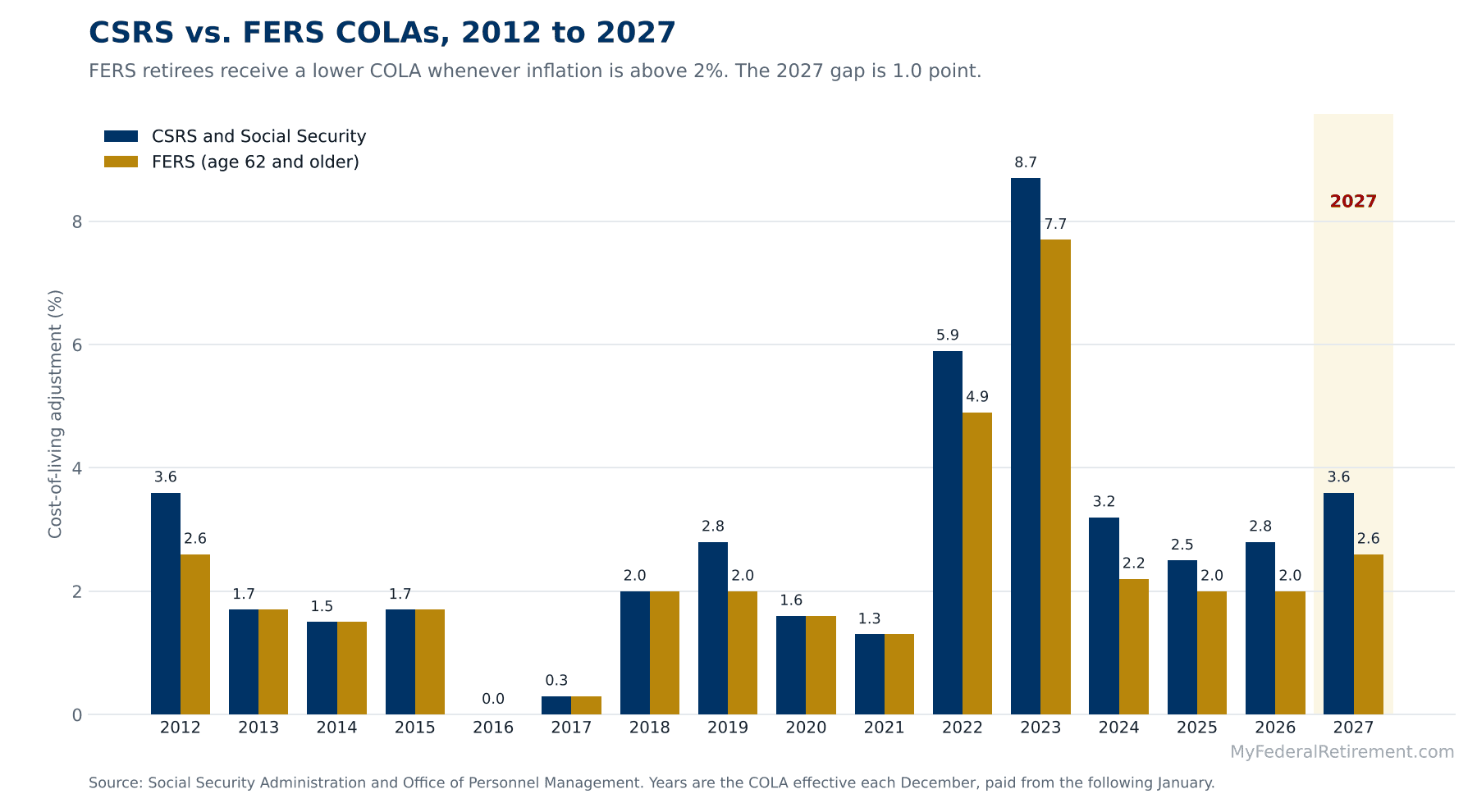
Quick summary: Based on CPI-W data through August 2026, the trend toward an estimated 2027 COLA rises to 3.5% for Social Security and Civil Service Retirement System (CSRS) retirees, up from 3.1% last month, which would translate to a Federal Employees Retirement System (FERS) COLA of approximately 2.5% once the FERS reduction formula is applied. One month of data remains before the Social Security Administration (SSA) finalizes the number in mid-October 2026. This page is updated monthly as new CPI-W data is released.


Get an alert when 2027 Federal Retiree COLA is officially announced

Enter your email on this form (opens in new tab) and receive an email alert as soon as the 2027 CSRS/FERS and Social Security COLA is finalized.


2027 COLA Estimate at a Glance

As of August 2026, the trend toward a 2027 COLA is:

(328.481 − 317.265) / 317.265 x 100 = 3.54 (adjusted to the nearest 1/10 of 1 percent = 3.5%)

The Consumer Price Index for September 2026 is scheduled to be released on October 14, 2026. The official 2027 COLA will be released by the SSA in mid-October 2026. The SSA calculates the percent change between average prices in the third quarter of the current year (ending September 30) and the third quarter of the previous year.

Advertisement

How Is a COLA Calculated?

The Social Security Act specifies a formula for determining each cost-of-living adjustment (COLA). COLAs are based on increases in the Consumer Price Index for Urban Wage Earners and Clerical Workers (CPI-W), which is calculated monthly by the Bureau of Labor Statistics (BLS).

A COLA effective for December of the current year equals the percentage increase, if any, in the average CPI-W for the third quarter of the current year over the average for the third quarter of the last year in which a COLA became effective. Any increase is rounded to the nearest tenth of one percent. If there is no increase, or the rounded increase is zero, there is no COLA.

SEE ALSO: Guide to Federal Retiree COLAs: What Are They and How Are They Calculated?

Why FERS Gets a Smaller COLA Than CSRS

CSRS retirees and Social Security beneficiaries receive the same COLA percentage. FERS retirees receive a reduced version, often called the “FERS diet COLA,” based on this formula:

If the SSA/CSRS COLA is… The FERS COLA is…
2% or less The same as the SSA/CSRS COLA (no reduction)
Between 2% and 3% A flat 2%
Above 3% The SSA/CSRS COLA minus 1 percentage point

Applying the current 3.5% trend: since it’s above 3%, the FERS estimate is 3.5% − 1.0% = 2.5%. That one-point gap looks small in a single year, but compounded over a 20–30 year retirement, it steadily erodes FERS purchasing power relative to CSRS and Social Security.

Note: the FERS Special Retirement Supplement, paid to some FERS retirees between their retirement date and age 62, does not receive a COLA at all, regardless of inflation.

What This Could Mean in Dollars

Using the current 3.5% Social Security/CSRS trend and the resulting 2.5% FERS estimate, here’s what a 2027 COLA could mean at a few common monthly annuity levels:

Monthly Annuity CSRS / Social Security Increase (3.5%) FERS Increase (2.5%)
$1,500 +$52.50/month (+$630/year) +$37.50/month (+$450/year)
$2,500 +$87.50/month (+$1,050/year) +$62.50/month (+$750/year)
$4,000 +$140/month (+$1,680/year) +$100/month (+$1,200/year)

For context, the average Social Security retirement benefit was about $2,071/month in early 2026. At a 3.5% COLA, that benefit would rise by roughly $72.50/month — before the Medicare Part B offset described below.

The Medicare Part B Premium Offset

A COLA increase rarely reaches a retiree’s bank account in full, because the standard Medicare Part B premium typically rises at the same time — and for most beneficiaries, that premium is deducted directly from the Social Security check.

Based on the 2026 Medicare Trustees Report (released June 2026), the standard Part B premium is projected to increase from $202.90/month in 2026 to approximately $209.50/month in 2027 — an increase of about $6.60/month. (The official premium is set by the Centers for Medicare & Medicaid Services later in the year and can differ from this projection; some private forecasters expect the final number to land higher, in the $216–$219 range.)

Net effect example: for a retiree receiving the average $2,071 Social Security benefit, a 3.5% COLA would add about $72.50/month. After the projected $6.60 Part B increase, the net increase that actually shows up in the deposit is closer to $65.90/month.

Federal retirees who receive both a CSRS or FERS annuity and a separate Social Security benefit should apply this offset only against the Social Security portion, since Part B premiums aren’t deducted from CSRS/FERS annuity payments directly unless separately enrolled through the Office of Personnel Management’s (OPM) premium conversion options.

One Month of Data Left

August is the second of the three months the SSA uses to set the 2027 COLA. September’s CPI-W, the final input, is scheduled for release on October 14, 2026, with the official COLA announcement following shortly after. Until then, the 3.5%/2.5% figures above represent a trend estimate, not a final number — a cooler or hotter September reading could still move the outcome in either direction.


2026 CSRS / FERS COLA Announced

October 24, 2025

The 2026 federal retiree cost-of-living adjustment (COLA) was 2.8 percent for those under CSRS and 2.0 percent for those under FERS.

This was slightly larger than the 2025 COLA, which was 2.5 percent for CSRS retirees — but the same for those under the FERS retirement system.

Read: Federal Retiree COLA History

The 2.8 percent 2026 COLA was also issued to those receiving Social Security benefits, with beneficiaries seeing the new COLA increases starting in January 2026.

Social Security began notifying people about their new benefit amount starting in early December 2025. Individuals with a personal my Social Security account can view their COLA notice online. Social Security beneficiaries receive a newly designed, simplified COLA notice — a single page, using plain and personalized language, with exact dates and dollar amounts of a person’s new benefit amount and any deductions.

Some other adjustments that take effect each January are based on the increase in average wages. For 2026, the maximum amount of earnings subject to the Social Security tax (taxable maximum) increased to $176,100 from $168,600.

What Is the Difference Between the CPI-U and the CPI-W?

The BLS describes it this way: the Consumer Price Index for All Urban Consumers (CPI-U) is a more general index and seeks to track retail prices as they affect all urban consumers. It encompasses about 87 percent of the United States’ population. The CPI-W is a more specialized index and seeks to track retail prices as they affect urban hourly wage earners and clerical workers. It encompasses about 32 percent of the United States’ population and is a subset of the CPI-U group. The CPI-W places a slightly higher weight on food, apparel, transportation, and other goods and services. It places a slightly lower weight on housing, medical care, and recreation.

Related:

  • Federal Retiree COLA History: CSRS COLA and FERS COLA
  • Lawmaker Reintroduces Equal COLA Act for Federal Retirees
Advertisement

Primary Sidebar

Recent Must-Reads

How AI Workforce Changes Could Affect Your Retirement Date, Pension, and Paperwork

OPM Weighs Changes to FEHB Health Plan Options

Footer

About Us
Contact Us
Advertise

Free Email Newsletter
Facebook
Twitter

Terms of Service
Privacy Policy
Cookies Policy

My Federal Retirement is not affiliated with the U.S. Federal Government.
Copyright © 2007-2026 My Federal Retirement. All Rights Reserved. Reproduction without permission prohibited.